The Four Burner Theory
Originally shared by @thecurioustales on X (Twitter)
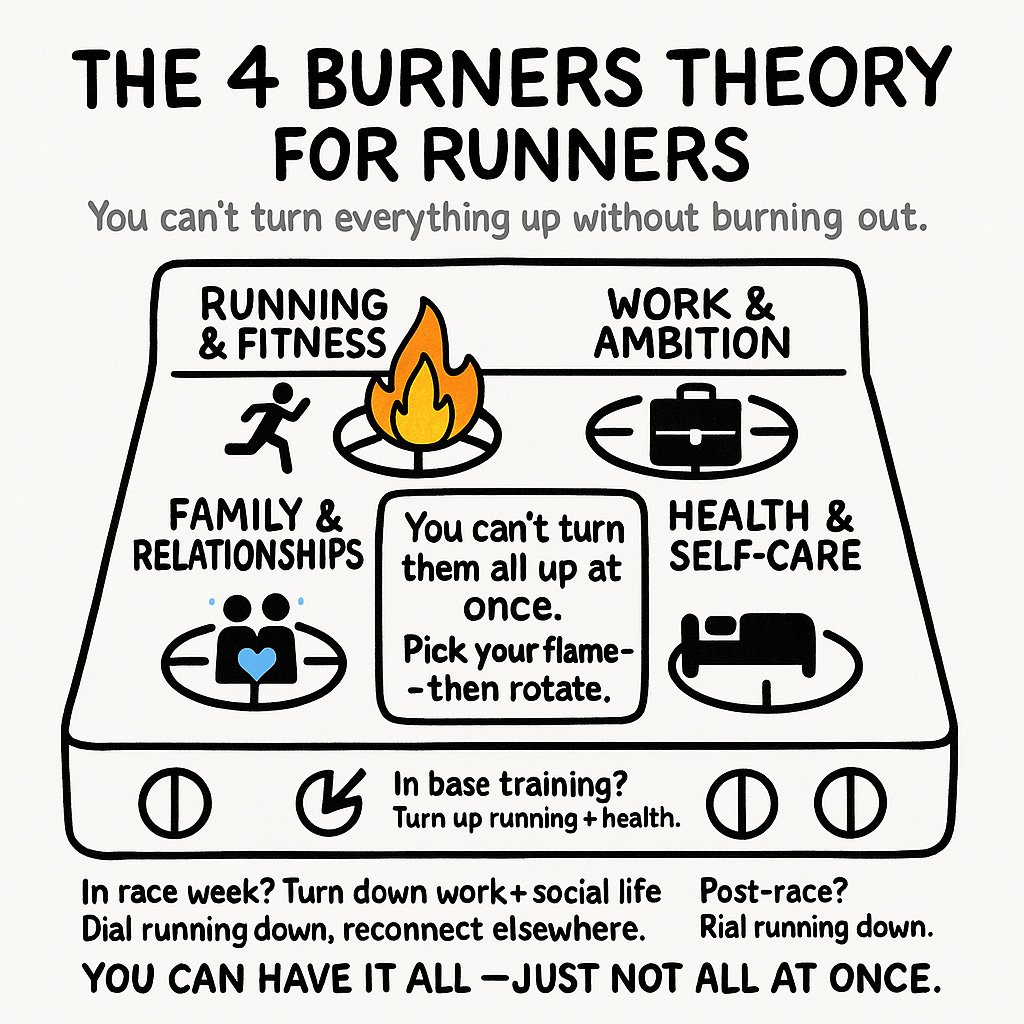
Imagine your life as a stovetop. You've got 4 burners:
- Family — connection, marriage, kids
- Work — career, business, ambition
- Health — sleep, fitness, energy
- Friends — social life, joy, belonging
Each takes gas. Each needs time. But you only have so much fuel.
In reality: To be successful… You have to turn off one. To be really successful… You must turn off two.
The Origin Story
The Four Burner Theory isn't some business school framework or self-help guru's invention. It comes from humorist David Sedaris, who casually mentioned it during a dinner conversation—describing it as a joke about the impossibility of having it all.
But something about it stuck. High performers everywhere recognized the painful truth beneath the humor. The idea spread through Silicon Valley, Wall Street, and elite circles, becoming an unspoken acknowledgment of what success truly costs.
The High Performer's Dilemma
The theory explains some famous outcomes:
- Elon Musk's first marriage — destroyed by the theory in action, as work consumed nearly every waking hour
- Jeff Bezos — jacked but divorced, having sacrificed personal relationships for Amazon's growth
- Mark Zuckerberg — no real friends, having devoted his life to building Facebook
These aren't exceptions. They're the pattern. When you commit to being extraordinary in one domain, good enough has to be enough in others.
The Math Doesn't Lie
Consider the arithmetic: there are only 24 hours in a day. Even if you sleep 8 hours, you have 16 waking hours. Between commute, meals, hygiene, and other necessities, you're left with perhaps 10-12 hours of meaningful time.
Now allocate those hours across four burners:
- Career success typically requires 10-14 hour days, especially in the growth phase
- Family presence demands quality time—being physically present but mentally checked out doesn't count
- Health maintenance—gym, sleep, cooking healthy meals—takes 1-2 hours daily minimum
- Friendships require regular contact, remembering details, showing up
The math simply doesn't work. Something must be deprioritized.

The Trap of "Having It All"
Here's the uncomfortable truth: the people who claim to have it all are usually lying—to themselves or to you. They're either:
- Sacrificing in silence — their marriage is struggling, their health is declining, or they haven't seen friends in months
- Running on fumes — they're burning out, and it will catch up with them
- Paying for help — they have nannies, personal trainers, and assistants compensating for their absence
- Defining "all" differently — their version of success doesn't include what you consider essential
Making the Choice Consciously
The Four Burner Theory isn't about despair—it's about awareness. The worst case isn't choosing to turn off burners. The worst case is pretending you don't have to choose, then being surprised when something collapses.
The most successful people make this choice consciously. They're not confused about what's happening. They've made peace with the tradeoffs. That clarity is what separates sustainable success from spectacular burnout.
The Tradeoff
The Four Burner Theory suggests that you cannot have it all. Something must give. The question isn't whether you'll sacrifice—it's what you'll sacrifice.
For some, that's family. For others, it's health. Or friends. The burners you keep lit define the life you live.
The real question isn't: "How can I have all four?"
The real question is: "Which two am I willing to let go of? And do I have the courage to admit it?"